Accounting / enterprise reporting
SAP BusinessObjects migration assessment
Led an Accounting migration assessment that showed why Power BI alone could not support most of a much larger BusinessObjects reporting estate.
Recommendation accepted; broader development moved to enterprise IT- Business question
- Could Power BI carry hundreds of BusinessObjects reports as a standalone migration target?
- My role & scope
- Project lead and team Scrum Master; later Accounting business lead
- Consequential contribution
- I repaired and migrated proof-of-concept reports, assembled platform and dependency evidence, and recommended changing the migration approach.
- Outcome
- The VP accepted my recommendation to change course. Enterprise IT took on the broader solution, and I became the Accounting business lead.
01 / Judgment
The problem and the choice
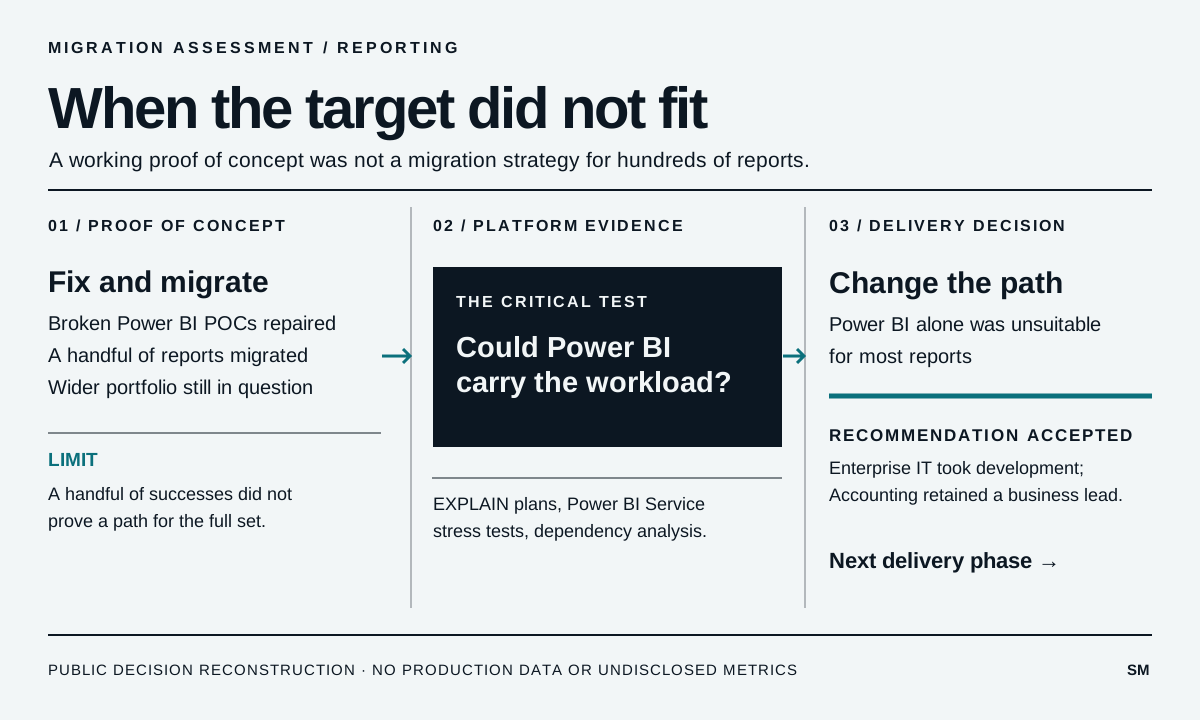
I joined a project to move SAP BusinessObjects reporting to Power BI. After fixing broken proof-of-concept reports, I became project lead and team Scrum Master. Much of the reporting logic lived in BusinessObjects universes. The estate contained hundreds of reports, while only a handful were migrated for the proof of concept.
Test Power BI against representative reports and their underlying constraints before extending the migration approach across the estate.
02 / Delivery responsibility
What I owned
I investigated the data size, semantic complexity, and upstream dependencies behind the reports. I brought together EXPLAIN plans, Power BI Service stress-test results, and the proof-of-concept work to show where a Power BI-only migration would fall short.
- Repaired broken Power BI proof-of-concept reports and migrated a handful of BusinessObjects reports.
- Investigated data volume, semantic complexity, and upstream dependencies across the wider estate.
- Assembled query plans and Power BI Service stress-test evidence for the platform decision.
- Presented the recommendation and continued as Accounting business lead after enterprise IT took on development.
03 / Working with others
How the work moved forward
I led the assessment and served as team Scrum Master. The VP accepted my recommendation; enterprise IT took on development of the broader solution, and I became the Accounting business lead.
04 / Technical detail
The implementation decisions
- Semantic dependency
- Much of the reporting logic lived in BusinessObjects universes, so copying individual report screens would not resolve the wider migration requirements.
- Platform constraints
- EXPLAIN plans, Power BI Service stress tests, data size, and upstream dependencies informed the assessment.
- Proof-of-concept scope
- A handful of reports demonstrated the initial path; hundreds of reports formed the estate being assessed.
05 / Validation
Validation evidence
The limited report migrations tested what could move. Query plans, service tests, and dependency analysis supplied evidence of constraints affecting the wider estate. That evidence supported the recommendation to change course.
06 / Outcome & status
What changed
The VP accepted my recommendation to change course. Enterprise IT took on the broader solution, and I became the Accounting business lead.
This result was an accepted platform recommendation and limited proof of concept. It was not a completed migration of hundreds of reports.